This past week, I wasn’t “on a job.”
I was attending my daughter’s school play, visiting a local theater, and going about normal day-to-day life.
But when you’ve spent years in facilities and operations, you don’t really turn it off.
You notice things.
And what I saw this week is exactly why so many organizations—schools, entertainment venues, and commercial properties—quietly lose money, increase risk, and fall behind operationally without realizing it.
The Pattern Most People Miss
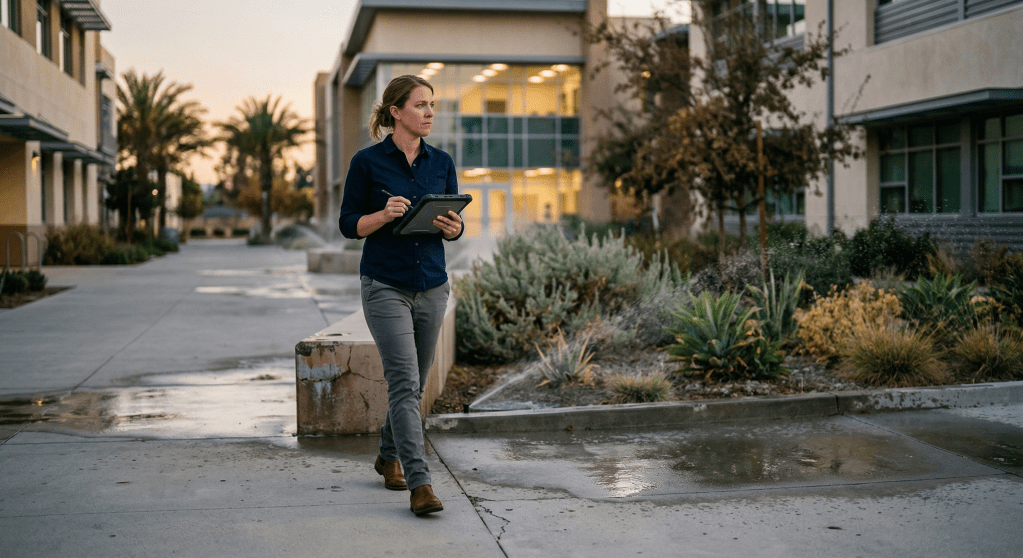
At a beautiful school campus, I noticed something subtle but telling:
- Landscaping in some areas was clearly under-watered
- Other areas had irrigation running excessively in the evening
- Water was being wasted while plants elsewhere were struggling
This isn’t just a landscaping issue.
It’s a systems issue.
It suggests:
- No recent irrigation audit
- Inefficient water management
- Gaps in vendor oversight or maintenance scheduling
This is something I see often across facilities here in San Diego and throughout Southern California—especially where water management should be a priority but isn’t being actively monitored.
And when one system is off, it’s rarely the only one.
It’s Never Just One Issue
At another location—a theater—I noticed:
- A restroom with exposed wiring (a clear safety hazard)
- A soda machine dispensing water with a moldy taste
Again, these aren’t isolated problems.
They point to something bigger:
- Missed inspections
- Gaps in preventive maintenance
- Lack of accountability in service contracts
These are the kinds of issues that don’t just affect operations—they impact:
- Customer experience
- Liability exposure
- Brand perception
Why These Things Slip Through the Cracks
Here’s the reality:
Most organizations are focused on their primary mission.
- Schools focus on education
- Theaters focus on guest experience
- Businesses focus on revenue and growth
Facilities often become reactive instead of strategic.
And internal teams—no matter how capable—are often:
- Overextended
- Pulled in multiple directions
- Focused on immediate needs instead of long-term optimization
The Value of a Trained, Outside Perspective
This is where having a third-party perspective makes a measurable difference.
At Chastain Facilities & Capital Advisory, the focus isn’t just on identifying issues—it’s about understanding how everything connects.
That means:
- Seeing patterns across systems—not just isolated problems
- Identifying root causes, not just symptoms
- Building a prioritized, actionable plan
- Aligning vendors, contracts, and expectations
- Supporting execution—not just handing over a checklist
Because a true facility assessment isn’t about pointing things out.
It’s about creating clarity, control, and a path forward.
It’s Bigger Than Maintenance
What I do at Chastain Facilities goes well beyond a walkthrough.
It’s about helping organizations:
- Reduce waste (water, energy, and operational inefficiencies)
- Improve safety and compliance
- Extend the life of their assets
- Bring structure to vendor management
- Plan proactively instead of constantly reacting
The walkthrough is just the starting point.
A Simple Question to Consider
If someone walked your facility today with a trained eye…
What would they notice that you’ve gotten used to?
Final Thought
Most facility issues don’t start as major problems.
They start small—like uneven irrigation, a missed inspection, or a neglected piece of equipment.
Over time, those small issues compound into real cost, risk, and inefficiency.
The difference isn’t just maintenance.
It’s awareness, structure, and execution.
And sometimes, it starts with a fresh set of eyes.
If you’re managing a facility in San Diego, anywhere in Southern California, or nationwide and want a clearer picture of what’s working—and what’s not—I’m always open to a conversation.
 Chastain Facilities & Capital Advisory
Leave a comment